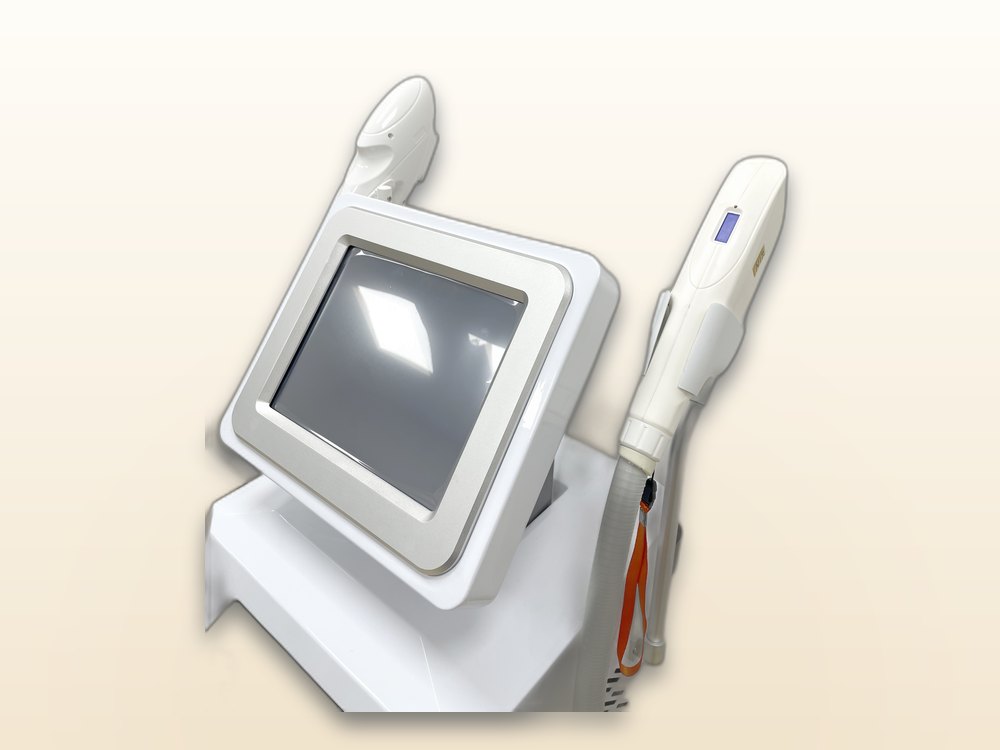
Modern beauty studio and medical spa clients increasingly demand immediate red-carpet luminosity—even skin tone, calmed cheek redness, and taut jawline bounce—without laser crusting, numbing creams, or social downtime. A DPL + NIR 900-1800nm milk light machine pairs two complementary light bands inside one high-turnover workstation: narrowband 500–600 nm Delicate Pulse Light (DPL) clears superficial redness and dull pigment, while 900–1800 nm Near-Infrared (NIR) “Milk Light” gently warms dermal water to 41°C–43°C for instant porcelain radiance and progressive collagen toning.
Clinical Engineering Callout: Why 900–1800 nm Near-Infrared “Milk Light” Achieves Pain-Free Tightening
Unlike visible-light IPL flashes that snap painfully against epidermal melanin, 900–1800 nm Near-Infrared (peaking around 1,300 nm) completely ignores melanin and hemoglobin—targeting dermal interstitial water at 1.5–3.0 mm depth instead. Delivered via continuous in-motion gliding over chilled sapphire crystal, NIR generates soothing deep warmth that accelerates microcirculation, drains facial puffiness, and stimulates fibroblast collagen synthesis across all Fitzpatrick I–VI skin types with zero pain.
1. Dual-Spectrum Optical Physics: DPL Narrowband vs. NIR Near-Infrared
Legacy broadband IPL handpieces struggled in high-volume beauty salons because they relied on high-intensity single-shot stamping—requiring experienced operators to avoid grid burns and leaving sensitive clients flushed or crusted for days. Engineering dual specialized optical handpieces on the DPL + NIR Milk Protein Light Photofacial System solves both safety and comfort challenges cleanly:
- Handpiece 1 — Narrowband DPL (500–600 nm / 550–650 nm): Dielectric interference filters slice off unnecessary infrared tails above 600–650 nm, focusing light strictly onto oxyhemoglobin (vascular flushing, post-acne red marks) and superficial epidermal melanin (dullness, sunspots, uneven tone). Operating in fast 3–5 Hz sliding motion keeps treatments gentle yet crisp.
- Handpiece 2 — NIR Milk Protein Light (900–1800 nm): Continuous wave or rapid-pulse near-infrared light penetrates smoothly into the upper-to-mid reticular dermis, warming collagen fibers to 40°C–42°C without blistering epidermal pigment—making it 100% safe year-round even on tanned summer skin or Fitzpatrick IV–VI clients.
- Sapphire Contact Chill Window: Active thermoelectric semiconductor cooling chills both sapphire windows down to 0°C–5°C continuously, protecting the surface barrier while delivering smooth, relaxing thermal comfort.
2. Clinical & Business Parameter Matrix: DPL vs. NIR vs. Legacy IPL
Compare chromophore absorption, client sensation, phototype safety, and salon ticket positioning across photofacial modalities:
| Engineering & Salon Metric | DPL (500–600 / 550–650 nm) | NIR Milk Light (900–1800 nm) | Traditional Broadband IPL |
|---|---|---|---|
| Target Chromophores | Oxyhemoglobin & superficial melanin | Dermal interstitial water (melanin-blind) | Broad melanin, hemoglobin & water mix |
| Penetration Depth | 0.5 – 1.5 mm (Upper dermis) | 1.5 – 3.0 mm (Mid reticular dermis) | 0.5 – 4.0 mm uncontrolled spread |
| Application Technique | Fast sliding or light stamping over gel | Continuous smooth circular gliding | Single stationary high-fluence stamps |
| Fitzpatrick Safety Ceiling | Fitzpatrick I – IV | Fitzpatrick I – VI (All skin tones) | Fitzpatrick I – III (burns dark skin easily) |
| Client Comfort Score | Mild warm rubber-band snap (2/10) | Soothing warm stone massage (0/10 pain) | Sharp heat sting (5–7/10) |
| Social Downtime | 0 hours (instant glow) | 0 hours (instant de-puffing & lift) | 24–72 hrs redness or dark speckling |
3. Step-by-Step “Porcelain Milk Skin” Salon SOP (45-Minute Signature Menu)
Beauty studios achieve the highest membership renewal rates when bundling DPL brightening and NIR thermal toning into one cohesive 45-minute luxury facial workflow:
- Phase 1 — Barrier Prep & Optical Gel (5 min): Cleanse skin with mild amino-acid foam, remove all metal jewelry and makeup, fit opaque protective eye goggles on the client, and spread a clean 2–3 mm layer of crystal-clear cooling conductive gel across the face and neck.
- Phase 2 — DPL Precision Clarity Sweep (10 min): Using the 500–600 nm (redness/PIE) or 550–650 nm (dullness/pigment) handpiece in In-Motion mode (8–11 J/cm², 3–4 Hz), glide smoothly in two overlapping horizontal and vertical passes across the cheeks, nose, forehead, and jawline until mild rosy luminosity appears.
- Phase 3 — NIR 900–1800 nm Milk Light Toning (15 min): Switch to the NIR handpiece and perform continuous upward lifting circles along the jawline, nasolabial folds, malar cheeks, and forehead (targeting 40°C–42°C gentle dermal warmth via handpiece feedback). Notice immediate lymphatic de-puffing and porcelain translucency.
- Phase 4 — Cold Peptide Mask & SPF Seal (15 min): Wipe gel gently, apply a chilled niacinamide or collagen-peptide sheet mask (optionally paired with 10 minutes of 633 nm red LED), and finish with ceramide moisturizer plus mineral SPF 50+.
4. Why NIR Milk Light Solves Sensitive Skin & Summer Seasonality Slumps
Traditional brightening lasers and deep chemical peels experience steep revenue drops every summer when clients spend weekends outdoors and arrive lightly tanned—too risky for high-energy melanin-targeting shots. Because DPL + NIR 900-1800nm milk light machine protocols rely heavily on melanin-blind 900–1800 nm NIR thermal toning alongside gentle low-fluence DPL sweeping, salons retain booming facial bookings 12 months a year.
Even clients with thin, barrier-compromised cheeks who react poorly to exfoliating acids or aggressive RF needles enjoy NIR Milk Light’s anti-inflammatory microcirculation boost—walking out visibly brighter, hydrated, and camera-ready immediately before weddings or corporate events.
5. Menu Pricing, Consumable Cost & Studio ROI Modeling
From an aesthetic business perspective, xenon DPL flashlamps and long-life NIR quartz lamps support 200,000 to 500,000+ pulses per handpiece—translating to remarkably low per-treatment lamp depreciation (under $1.50–$3.00 per facial including conductive gel and sheet mask). Pricing a 45-minute “DPL + NIR Milk Light Porcelain Facial” at $150–$240 single session (or $990 for a 6-session bi-weekly luminous series) generates >90% gross margin while turning over treatment rooms effortlessly with entry-level or intermediate estheticians.
For multi-room franchise salons, pairing DPL+NIR brightening with comprehensive salon treatment menu SOP engineering creates an unstoppable front-end client acquisition magnet that feeds higher-ticket body contouring and anti-aging memberships.
6. Contraindications, Lamp Maintenance & Optical Safety Rules
- Strict Contraindications: Avoid firing DPL or NIR over active cold sores, open facial wounds, acute eczema flares, tattoos, eyebrows, or clients taking photosensitizing medications (isotretinoin within 6 months, doxycycline, St. John’s wort), as well as pregnant clients.
- Coolant & Gel Hygiene: Use strictly distilled water in the internal chiller reservoir (refreshed every 60–90 days) and wipe sapphire handpiece lenses immediately after every session with soft 70% alcohol swabs so dried gel never bakes onto the optical crystal.
- Consistent Sun Habits: Educate clients to apply broad-spectrum sunscreen daily for 7 days following DPL sessions to lock in crystal-clear tone without UV rebound.
7. Dual-Pass Handpiece Glide Ergonomics, Gel Layer Depth & Staff Training
Consistent clinical results across a busy beauty studio depend on standardizing handpiece velocity and optical coupling gel thickness across every esthetician on staff. Apply a continuous 2–3 mm cushion of crystal-clear water-based ultrasound gel across each treatment quadrant before activating the DPL + NIR 900-1800nm milk light machine—gel layers thinner than 1 mm allow warm sapphire rims to irritate sensitive cheek barriers, while overly thick opaque layers absorb photons unnecessarily. Glide the NIR handpiece smoothly in overlapping upward strokes from jawline to cheekbone at 3–4 cm per second so dermal water accumulates steady 40°C–42°C collagen warmth without ever pausing statically over bony prominences. Document energy fluence, pass count, and client skin tone response inside digital consultation logs after every session.
8. Seasonal Marketing Hooks & Bridal / Event Glow Packages
Position zero-downtime DPL + NIR Milk Light treatments as the flagship “Red-Carpet Porcelain Package” 48 to 72 hours ahead of weddings, graduations, and holiday photoshoots—capturing high-intent seasonal clients who refuse lasers or chemical peels near major events and converting them seamlessly into quarterly luminosity memberships.
Pre-Treatment Client Screening & Hydration
Remind salon clients to arrive well-hydrated and free of self-tanning lotions or heavy mineral foundation before DPL + NIR Milk Light photofacials. Thorough double-cleansing removes reflective zinc sunscreen residue so optical energy enters the dermis evenly without surface scattering.
Clinical Integration, Product Architecture & Pillar Reference
Upgrade your facial treatment menu with zero-downtime luminosity using the DPL + NIR 900–1800nm Milk Light Photofacial Machine. Explore full aesthetic workstation profitability and room-building strategies inside our salon & spa treatment menu SOP guide and facial care machine hub.
Frequently Asked Questions (Salon & Clinical)
What makes a DPL + NIR 900-1800nm milk light machine different from a basic IPL machine?
Basic IPL scatters broad wavelengths that overheat the epidermis painfully, whereas DPL isolates tight 500–600 nm vascular/pigment bands and pairs them with melanin-blind 900–1800 nm NIR water heating for zero-downtime brightening and collagen glow.
Is NIR Milk Light safe for dark or tanned skin tones?
Yes. Near-infrared 900–1800 nm wavelengths target dermal water rather than epidermal melanin, making NIR collagen toning safe across Fitzpatrick I–VI skin year-round.
How often can salon clients repeat DPL + NIR Milk Light facials?
NIR Milk Light can be performed weekly for gentle toning and hydration, while combined DPL + NIR porcelain brightening protocols are typically spaced every 2 to 3 weeks in courses of 4 to 6 sessions.